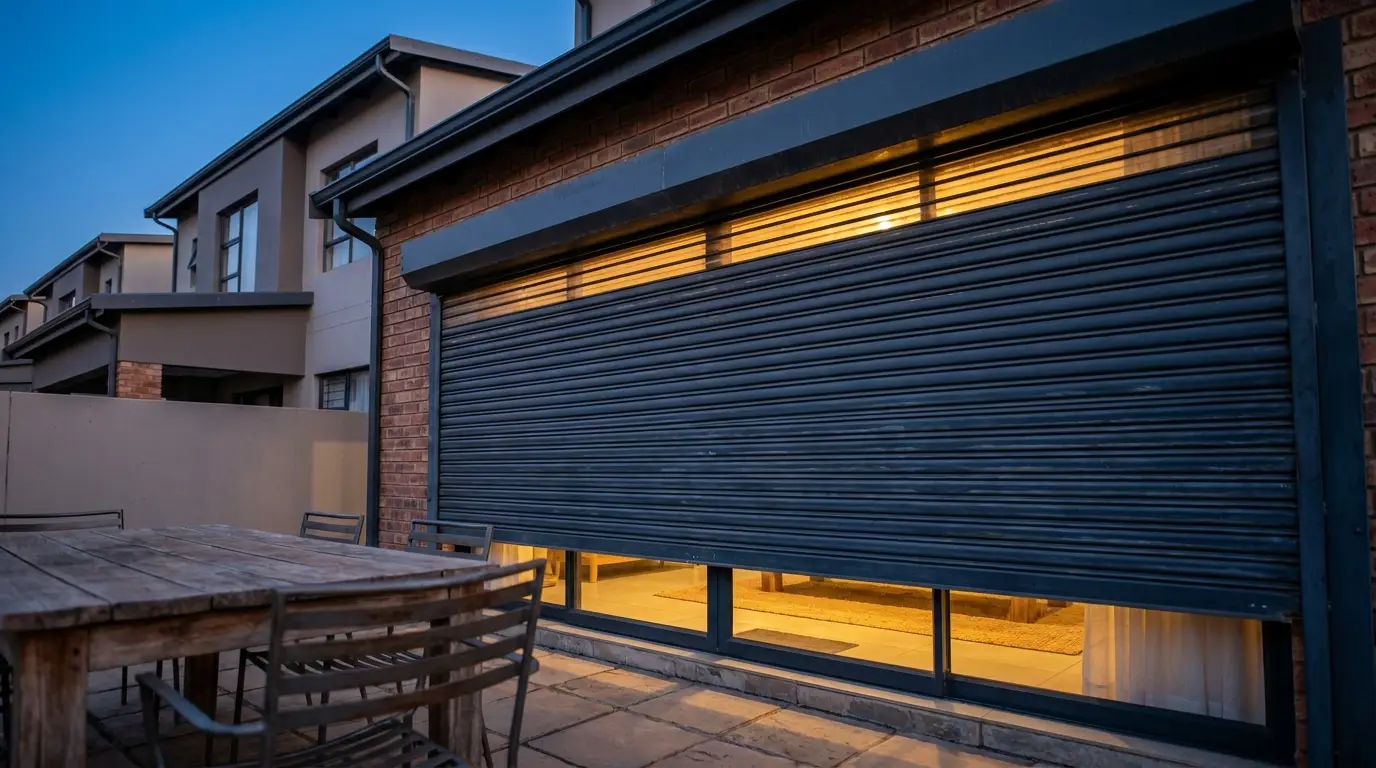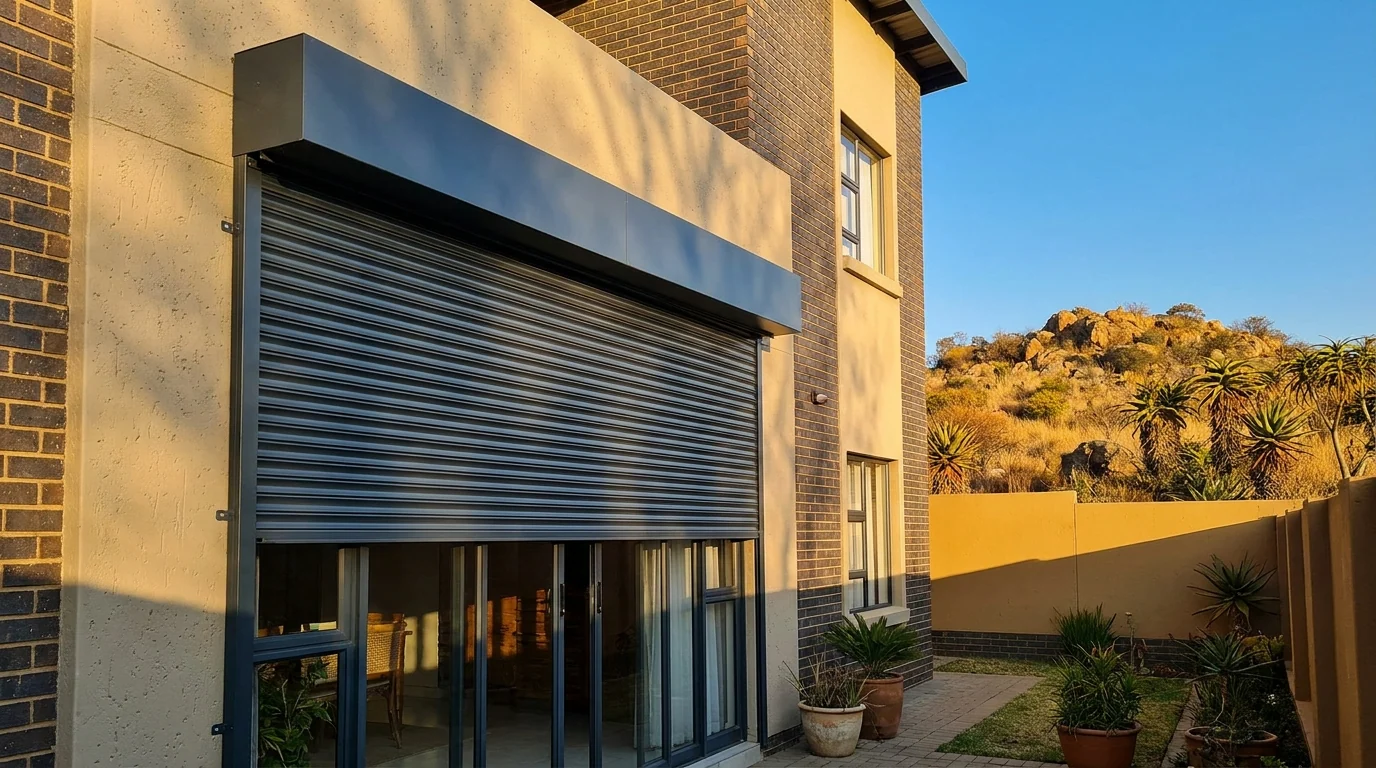
External aluminium roller shutter rolled down over the sliding doors of a Lonehill cluster home, with the rocky koppie rising beyond the boundary wall

Free · no sign-up · every figure sourced

The Lonehill Complex Light Handbook

How the Highveld sun crosses this suburb through the year, what it does to each elevation of a cluster or complex home — and what we would fit on each, with the honest catch on every answer.

Written for Lonehill, Fourways, Broadacres & Cedar Lakes, Helderfontein and Dainfern · about a ten-minute read · last revised August 2026

Why Lonehill is a different brief

Same sun as the rest of Johannesburg. Very different house.

Lonehill sits about 28 km north of the Johannesburg city centre, built tight around a rocky koppie some 80 metres high with a boulder balanced on its crown — the hill the suburb is named for, now a fenced reserve. Townhouse developments run right up to its perimeter, and that shapes most of the shading work here.

Because the housing is mostly cluster homes and walled complexes rather than big stands with old gardens, three things follow. Your neighbour's wall is close enough to matter. Your patio is small enough that a fixed roof would swallow it. And whatever you hang outside belongs to a scheme with trustees.

The exception is the units facing the koppie and Lonehill Loch, the dam north of it. Nothing breaks the low afternoon sun there, so those rooms take the full load — and have a view worth keeping. That distinction is most of the job.

Everything below is free, ungated and sourced at the foot of the page. Where we give an opinion, we say so.

The light here

Overhead in December, low and northern in June.

Johannesburg sits at latitude 26°11′ south. At noon on the December solstice the sun stands about 87.2° above the horizon — effectively overhead. At noon in June it reaches only about 40.4°, due north. That 47-degree swing is the whole of Highveld window shading in one number.

Day length follows: 13 hours 47 minutes in late December against 10 hours 30 minutes in late June. The sun rises due east only twice a year — in December at 116° at 05:12, setting at 243°, both south of the east–west line; in June at 64°, setting at 295°.

December and June sun paths over a Lonehill house December noon · ≈87° · almost overhead June noon · ≈40° · due north EAST — rises 05:12 in December WEST — sets 18:59 in December
The two extremes, drawn to Johannesburg's published solar altitudes. Everything an eave or awning can do sits between these curves.

Three local complications

Heat and cold at one address. January averages a high near 30 °C, July a low near 7.9 °C — five months shedding heat, three holding it. That is why we usually specify two fabrics in one house rather than one compromise everywhere.

The storm season lands at the wrong hour. Intense afternoon and evening thunderstorms run October to March. Satellite work on South African hail puts hail-producing storms at their peak between 16:00 and 17:00, Gauteng's season peaking in early November — the same hour a west lounge most wants its shade out. That is the strongest argument there is for retractable products over fixed ones.

Altitude makes the light harder than it looks. Highveld high pressure gives cloudless skies, and ultraviolet rises roughly 10% per 1,000 m of elevation; Lonehill averages about 1,428 m. Ultraviolet breaks the bonds holding fabric dye, so fabric choice here is a durability decision, not only an aesthetic one.

Elevation by elevation

Which of your windows is actually the problem.

Note which way each room's glass faces. The answers are ours; the reasoning is worth arguing with.

North

The easy one, if there is an eave

Near-vertical in midsummer, low and due north in midwinter — the one elevation where a horizontal projection blocks most of December while still letting the whole of June in.

Our view: if a north room is uncomfortable the shortfall is overhead, not at the glass. Fix that and the blind becomes a light-and-privacy decision.
West

The hard one, and usually the lounge

The sun sets between 243° in December and 295° in June, and by then it is low — arriving under the eave, straight at the glass. Usually that is the slider onto the small garden.

Our view: the one elevation where stopping the sun outside the glass genuinely beats anything fitted inside it.

East

05:12, in your bedroom

The mirror image of west, from 05:12 in midsummer. The building is still cool then, so the complaint is glare and being woken, not heat.

Our view: darkness beats thermal performance here, and at the edges — most east bedrooms are ruined by a strip of light down the side of the blind.

South

Cold, grey, and overlooked

Midsummer sunrise (116°) and sunset (243°) both sit south of the east–west line, so a south wall takes a little low sun in December and effectively none from April to August.

Our view: the enemy is heat loss and gloom, not glare — a heavy blockout would only make a dark room darker.

Optional

Want this handbook marked up for your own house?

Tell us which rooms are the problem and we will email you this same handbook with your elevations noted on it — which of the sections above apply to you, and which you can ignore. It is not a quote, no visit is booked, and nobody phones you about it.

Your details are used only to send you this handbook and, if you ask for it, to arrange a measure. They are never shared with any third party or sold (POPIA).

What we'd fit, and why

Six answers for Lonehill glass, each with its catch.

Each says what it beats and what it costs. Tap “add to my window list” and it is waiting, ticked, on the form below.

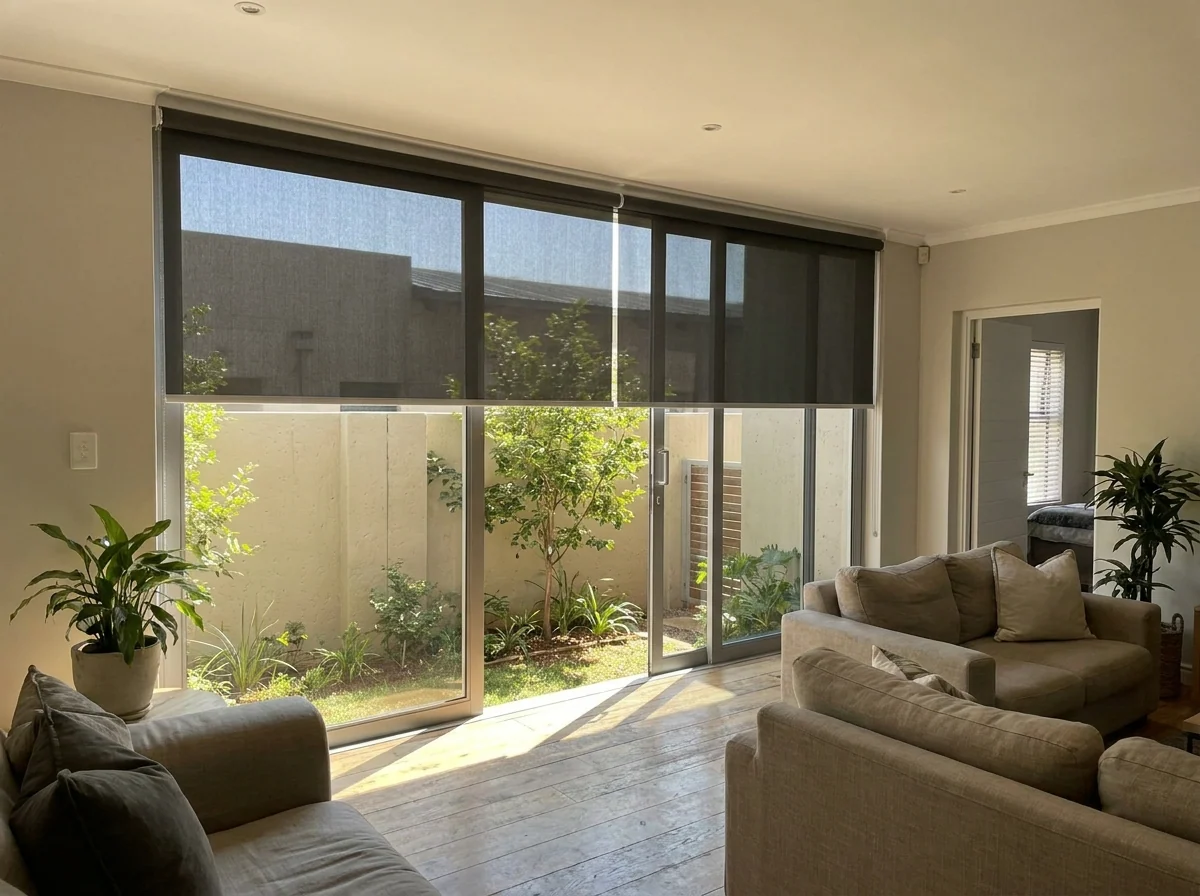
Sunscreen roller blinds — single smooth sheets of open-weave fabric on tubes — lowered over a wide slider onto a walled Lonehill courtyard garden

West living glass

Sunscreen roller blinds

One smooth sheet of open-weave fabric on a tube — no folds, no slats. It cuts glare and much of the heat while you keep the daylight and the view. On a west slider we put it ahead of a blockout, which turns your best room into a cupboard from four.

The honest catch: it is see-through by design, so after dark with the lights on, anyone outside sees in. Sitting there at night means a double roller, which costs more.
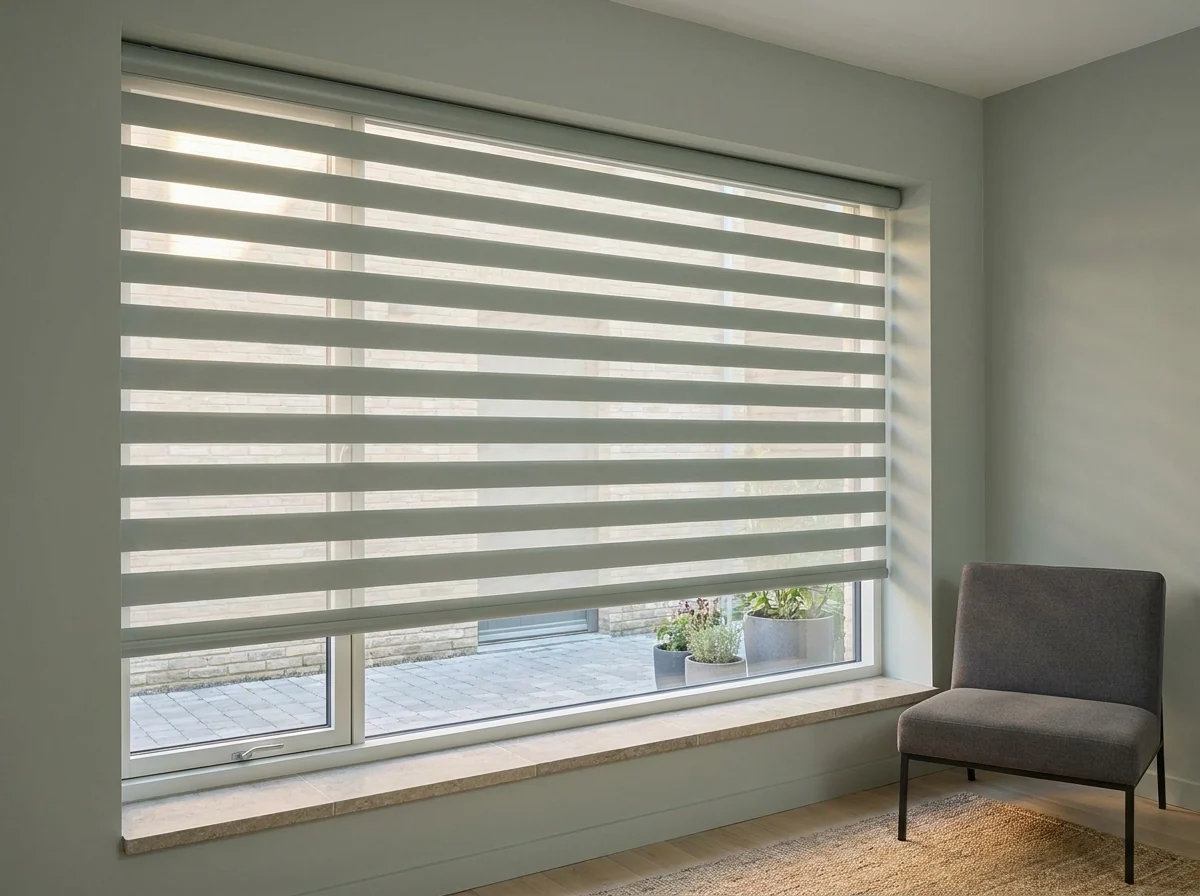
Day/night blind with alternating sheer and solid fabric bands on a lounge window facing a neighbouring townhouse wall and shared walkway

Lounges facing a neighbour

Day/night blinds

Alternating sheer and solid bands on one roller: line them up and the room closes off, slide them apart for filtered light and the view. Facing a wall four metres away it beats a vertical blind — privacy without giving up the window.

The honest catch: even fully closed it is not a blockout, so a bedroom never goes properly dark, and the two-layer fabric takes more care to clean.
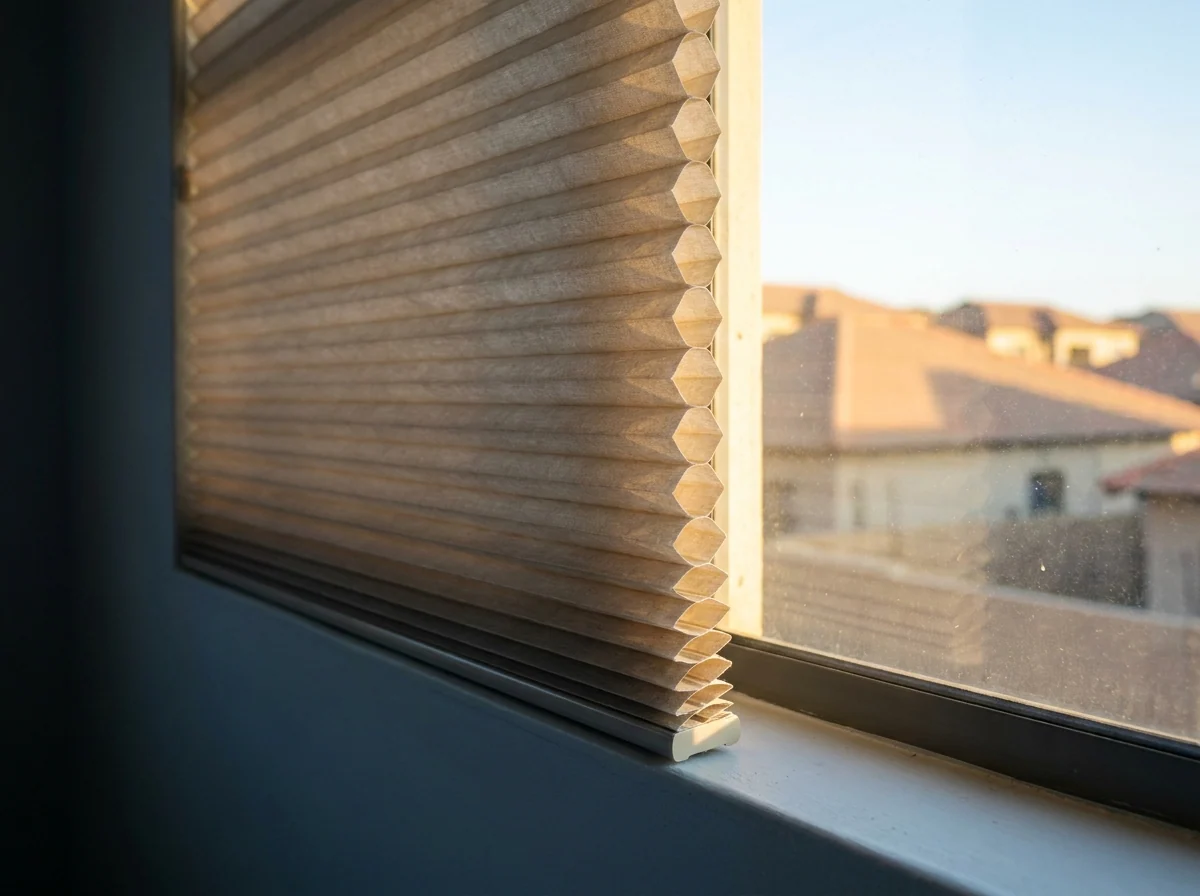
Cellular honeycomb blind seen in cross-section, its hexagonal air cells visible, at a west-facing upstairs bedroom window

Bedrooms that bake · south rooms that never warm

Cellular / honeycomb blinds

Hexagonal cells trap still air against the glass, so it works both ways: it takes the edge off an upstairs bedroom in January and holds warmth in on a July morning. Where the complaint is temperature, not glare, we reach for this first.

The honest catch: it is inside the glass, so the pane still heats and radiates: it manages heat, it does not stop it. Without side channels each edge leaks light.
External aluminium roller shutter partly lowered over a sliding patio door on a Lonehill townhouse at dusk, warm interior light glowing through the gap, braai table on the patio in the foreground

The worst west elevation

Roller shutters — for shading

Rigid aluminium slats rolling down from a headbox on the outside of the glass. On a bad west elevation this beats an interior blockout for a physical reason: stopping the sun before it reaches the pane keeps the room cooler than absorbing it inside, where the glass heats and radiates behind the blind.

The honest catch, and it is a real one: these are shading shutters, not security-rated ones — a different product, available on request, and we will not let anyone buy the one thinking it is the other. They are also the most visible thing on your façade, so trustee consent applies.
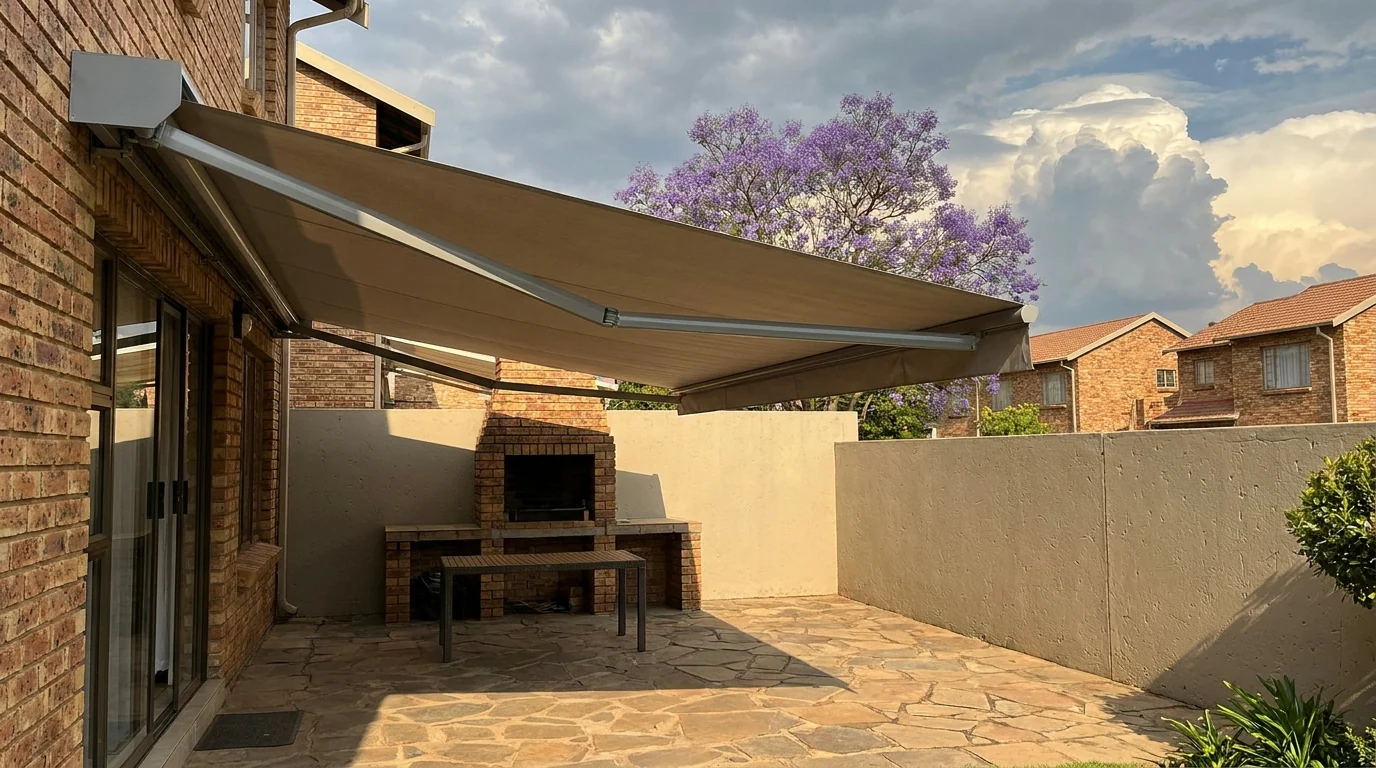
Folding-arm awning extended from a wall cassette over a compact complex braai patio, with a Highveld thunderhead building behind

The compact braai stoep

Folding-arm awnings

A fabric canopy on folding arms off a wall cassette — no posts, nothing standing in a small courtyard. We put it ahead of a fixed roof for one reason: hail peaks in early November and arrives mid-afternoon, so an awning comes in before the weather while a fixed roof takes the hit.

The honest catch: it needs a sound wall with clear height above the door, and in this ultraviolet the shade cloth is a wearing part, not a permanent one.
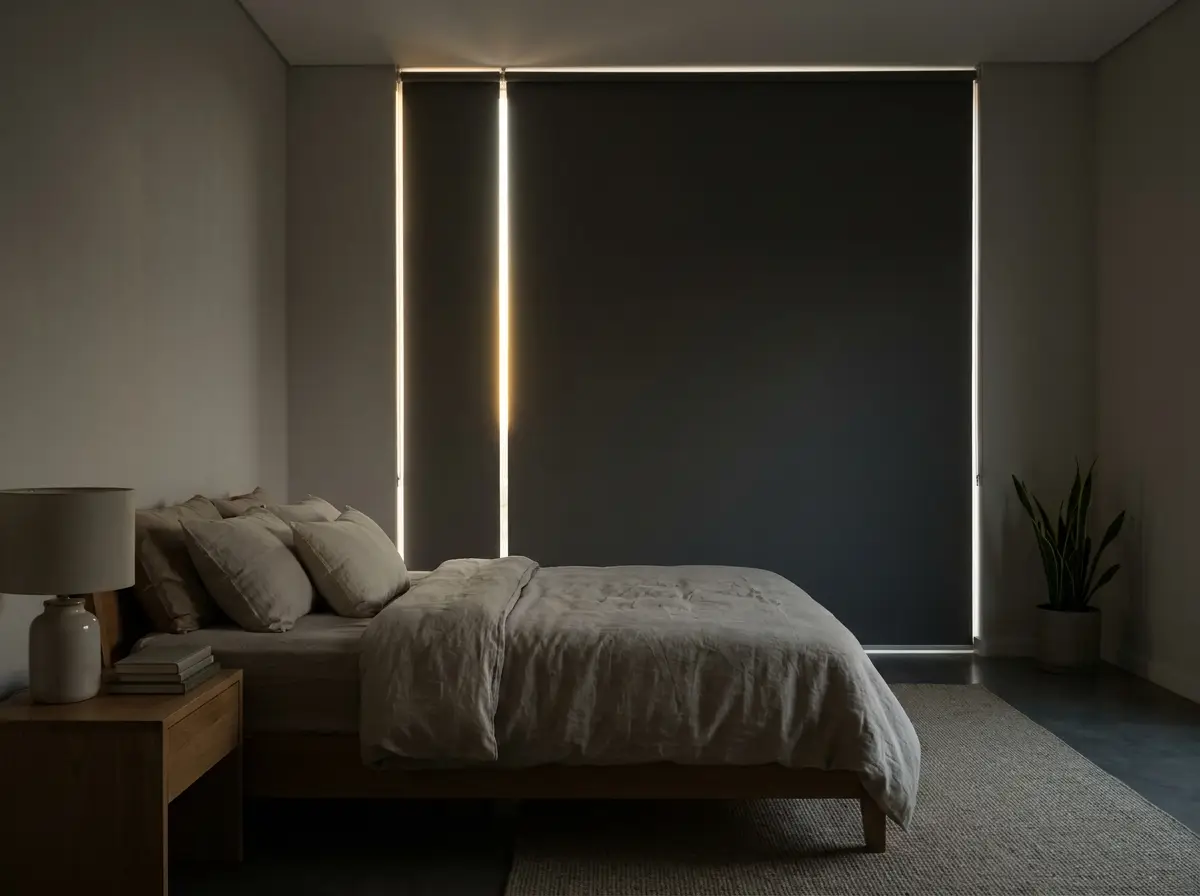
Dim Lonehill bedroom at dawn with a dark blockout roller blind lowered fully over the window, only a thin sliver of sunrise light showing at each edge

East bedrooms · media rooms

Blockout roller blinds

The same smooth sheet, in a fabric that stops light rather than filtering it. On an east bedroom taking a 05:12 sunrise it is the honest answer — day/night blinds and sunscreens both leave a bright room at dawn. Side channels close the edges.

The honest catch: it is all or nothing — down, the room is dark and viewless; up, you get the whole sunrise. A room that doubles as a study wants a second blind.

Four more that earn their place here

Zip screens hold outdoor mesh taut in side channels, for a gusty braai corner. Venetians give slat-by-slat control — aluminium where there is steam, timber for warmth. Vertical and panel blinds suit very wide sliders. And motorisation takes every cord off a façade the trustees can see.

Trustees, HOAs and estate rules

Inside the reveal is your decision. Outside it usually isn't.

Most Lonehill homes sit in a sectional-title scheme or an HOA, and that changes which of the products above is even available at your address. Under the prescribed conduct rules made under the Sectional Titles Schemes Management Act, an owner may not change the external appearance of a section without the trustees' written consent unless the change is minor and does not detract from the section or common property — and may not drive screws into common property without that same consent.

So an awning cassette, a zip-screen channel or a roller-shutter headbox is both a change to external appearance and a fixing into common property: a written-consent item, far cheaper to ask before fabrication than after. It is routine rather than adversarial — fitting awnings to north and west windows is common practice, and the rules usually specify only type and colour, so the building still reads as one from the road.

The estates nearby work the same way through a different door: Dainfern has been run by its homeowners' association since proclamation, under a memorandum of incorporation and estate rules. Those are not published, so we will not tell you what they say — only that your consultant will ask for them first.

Anything inside the reveal is generally your own business. That is not legal advice: your scheme's rules are the authority, and they differ.

The limits of a page

Five things this handbook cannot tell you.

These decide the specification, and each needs somebody on site.

  1. The actual reveal depth

    Whether a blind fits inside the opening — and whether a double roller, side channel or cassette fits with it — comes down to millimetres behind the plaster line. Complex windows are often just short, and that changes the product.

  2. What is behind the wall you want to fix into

    An awning or roller shutter pulls hard on its fixings. Whether that lintel or bulkhead carries it — and where fixings may land in a shared wall — is a look-and-tap job.

  3. How exposed that particular corner is

    Highveld storms produce gust fronts and microbursts with little warning, and two identical patios in one complex behave differently depending on how the wall funnels the wind. That decides between an awning with a wind sensor, a zip screen, or neither.

  4. Where the power is, if you want motors

    Battery motors retrofit cleanly; wired motors suit a renovation with an electrician on site. Which you should have depends on the nearest point, whether the route can be chased, and how many blinds share one control.

  5. What the room does at four o'clock

    The sun-path numbers above are the same suburb-wide. What they mean for your lounge depends on the neighbour's roofline, the wall height, and whether that window faces the open veld.

Two ways forward

Have us come and measure — or just get a range first.

Both start on the same short form. Neither commits you to anything.

Recommended

The free expert measure & written quote

A consultant comes to you with fabric samples, walks the elevations at the hour that matters, measures every opening, checks reveals and fixings, and leaves a written quote itemised per window. Free, with no obligation.

Book my free measure

We take five or six measure appointments a week across this belt, so the diary fills early.

Optional

Want a ballpark first?

Pop in rough sizes and we will send a budget range by the next working day. Not sure how to measure? Leave it — our consultant measures for free either way, and that visit is where exact per-window pricing comes from.

Open the window list

The close

Book your free expert measure.

One short form. If you would also like a budget range, add rough window sizes underneath it — that part is entirely optional and nobody will chase you for it.

What you're interested in (anything you added from the handbook is already ticked)
Optional: add rough window sizes for a budget range

Rough really is fine — a tape across the outside of the frame is enough for a range, and we will send that range by the next working day. If measuring is not your idea of a Saturday, skip this entirely: the free measure gives you exact per-window pricing either way.

Your window list — room, width, drop, mount and product for each window
Room Width (mm) Drop (mm) Inside or outside the reveal Product Remove

Nothing on the list yet — and that is completely fine.

Your details are used only to arrange this consultation call-back and, if you have added sizes, to send your budget range. They are never shared with any third party or sold (POPIA).

Sources

Where every figure on this page comes from.

Sun-path, climate, hail, ultraviolet, suburb and sectional-title figures are all taken from the following. Where a figure was disputed or we could not open the source, we left it out rather than round it into a sentence.

Reading this from a window nearby? The same sun-path reasoning applies across Fourways, Broadacres & Cedar Lakes, Helderfontein Estate and Dainfern — it is the housing stock, the exposure and the scheme rules that change.